MeikoLab
Personalized dog health guidance, designed for clarity
Human-Centered Product Experience
November 2022
MeikoLab was designed around the moment of uncertainty; the experience prioritizes clarity, reassurance, and trust. A guided search interface, warm visual language, and intuitive navigation work together to help dog owners quickly find reliable answers, without feeling overwhelmed or clinical.

Designing with Intention
Principles that guided every product decision.


Designing MeikoLab required clarity of intent around real user needs and behaviors. Guided by early storyboarding, I defined experience principles aligned to key user personas and their primary task, quickly understanding potential health concerns with confidence. These principles shaped layout, tone, and interaction decisions, ensuring that each screen responds to the user's mindset while remaining part of a cohesive, scalable system.


The challenge
Reducing anxiety while increasing trust.
Dog owners often seek health advice during moments of stress. Existing solutions felt clinical, fragmented, or overwhelming.
-
Warm, not medical
-
Intelligent, not intimidating
-
Trustworthy, not transactional


To deepen my understanding of the product experience, I developed a hand-drawn storyboard to visualize the user journey before finalizing interface decisions. By grounding the design in narrative flow, the home screen was able to express multiple entry states while staying aligned with the core product focus and user mindset.
Experience principles & interaction model
To translate research into consistent behavior, I defined experience principles that determine how the interface responds to the user's emotional state.


Warm
Supports reassurance during uncertainty.


Guided
Helps user move forward confidently.
Trust
Builds confident through clear insight and action.
Confidence Signals
The interface reinforces trust before asking the user to act, using professional validation and clear next-step confirmation.


-
Vet Insight Card: Provides professional context to help users interpret symptoms calmly.
-
Authority Indicator: Shows when information is medically reviewed to build credibility.
-
Confirmation State: Clarifies the recommended action and reduces decision uncertainty.
Scalable design system
The interface was formalized into reusable components and rules to ensure consistency as the product expands. This system allows new features to be introduced without changing how users understand or navigate the experience.

Color communicates intent before text, reinforcing user confidence at every step.
Reassurance context

Guided question state

Vet recommendation action state
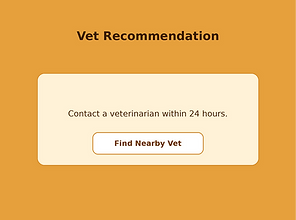
Color meaning is reinforced through repeated interaction states, allowing users to interpret urgency and guidance instantly without reading instructions.
Typography hierarchy


A consistent 8-point grid ensures predictable spacing, improving readability and interaction confidence during health decisions.
Rhythm & Breathing Room - Grid concept
Interaction architecture exploration
Before visual styling, flows were mapped through low-fidelity screens to validate behavior across real user situations, onboarding, reassurance, monitoring, and escalation. This ensured the interface logic worked before the interface aesthetics were defined.
New User Entry
Understanding the pet before advice can be trusted.

Guidance & Reassurance Flow
The system responds differently based on confidence level.
Daily usage needed clarity, not urgency

Ongoing Care & Monitoring
Daily usage needed clarity, not urgency.

Adaptive Interface Logic
The interface adapts to user's risk level while remaining structurally consistent.


Component Anatomy & Token Mapping
Interface Structure & Hierarchy Zones
Component Anatomy
Every component follows a defined structure, ensuring consistency across features and future expansion.


Conversation UI - System behavior & token structure
This diagram shows how the chat experience is built from repeatable system rules rather than individual screens. Layout, spacing, typography, and token usage work together to communicate priority, authorship, and action at a glance. By aligning message states, interaction feedback, and visual hierarchy, the interface consistently guides the user while reinforcing clarity and trust across every conversation.
Behavior Adapts to Context
The interface adjusts tone, guidance, and action based on the user's situation, shifting from reassurance to clarity to decisive direction while maintaining a consistent product system.

Systemized interface implementation
The following screens demonstrate how the interaction model translates into consistent product behavior across different user situations, ensuring users receive guidance, reassurance, and clear next steps without relearning the interface.


Each screen adapts to the user's level of certainty while maintaining a consistent interaction structure. The interface shifts expression, reassuring, guiding, or confirming, but the behavioral model remains predictable, enabling trust through familiarity rather than repetition.
Accessibility & Cognitive Load
The interface is designed to reduce cognitive strain by prioritizing clarity, hierarchy, and accessible contrast across all risk states. Information is layered progressively, actions are visually distinct, and urgency is communicated through structure and language, ensuring users can make confident decisions, even under stress.
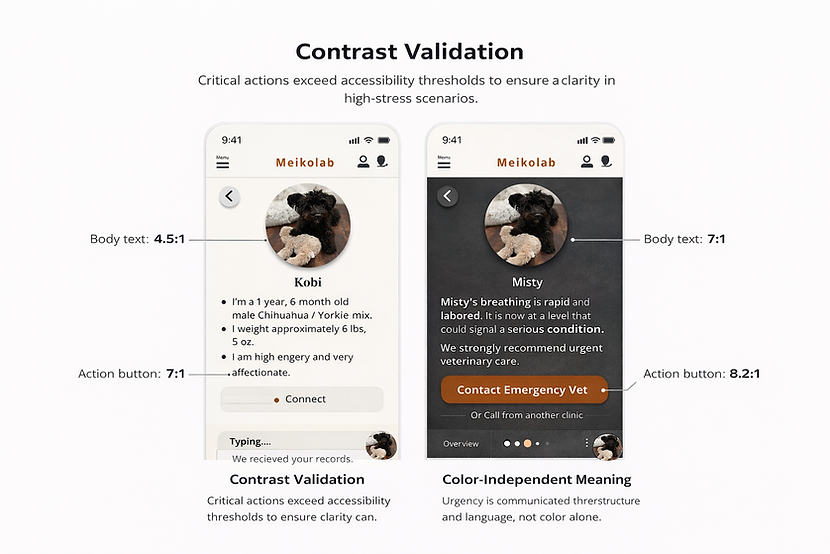
Critical actions exceed WCAG contrast thresholds to ensure clarity, legibility, and confident decision-making in high-stress scenarios.

Urgency is communicated through structure and language, not color alone.

Content is intentionally structured to elevate the primary action, reduce decision fatigue, and guide users clearly through moments of uncertainty.

Subtle, purposeful motion reinforces clarity, providing feedback and guidance without overwhelming the user durin critical moments.
Decision Confidence & Trust Signaling
Clear hierarchy, severity framing, and restrained emphasis guide users toward confident action in urgent situations.


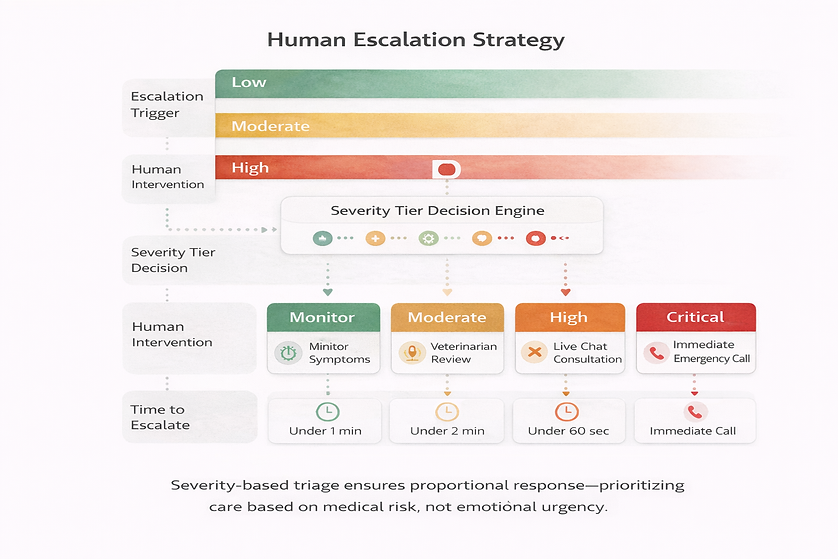
The severity tier decision engine maps clinical risk to predefined intervention pathways and response-time thresholds. By structuring escalation triggers, human handoff points, and time-to- response standards, the system ensures predictable, proportional care delivery across every risk level.

Escalation is not reactive; it is structured, tiered, and grounded in clinical judgment. By defining clear thresholds for AI triage and human intervention, the system ensures that every recommendation is proportional, documented, and aligned with real-world veterinary care.

The escalation model aligns AI triage with predefined severity thresholds to determine when monitoring, asynchronous review, live consultation, or emergency action is required. By anchoring decisions in risk-based logic, the system provides predictable, proportional responses while preserving human oversight for high-stakes scenarios.
Enterprise-Grade Care Infrastructure
Response times are governed by defined service-level thresholds, ensuring predictable care delivery at scale.


The system operates within defined service-level agreements to ensure reliable, timely care escalation. Performance metrics, including response time thresholds, review windows, and escalation routing, are continuously monitored across the AI triage engine, veterinarian review pipeline, and notification infrastructure. This governance layer ensures that every case is processed within measurable standards, maintaining both operational reliability and clinical accountability at scale.
High-Fidelity Product Experience
Translating system architecture into real user interactions.
The system architecture comes to life through a sequence of intuitive user interfaces designed to guide pet owners from symptom reporting to clinical support. Each screen translates complex veterinary logic into clear, actionable interactions, allowing users to describe symptoms, provide context, and receive informed care recommendations with confidence.
The high-fidelity prototypes translate the system's triage logic, escalation framework, and human oversight model into clear, intuitive user interactions. Each screen reflects the underlying infrastructice, guiding users from symptoms input through moniroting, escalation, and follow-up care, while maintaining clarity, trust, and proportional response across every severity level.
Guided Symptoms
Users begin by submitting essential medical context and symptoms, allowing the system to establish a baseline understanding before triage begins.


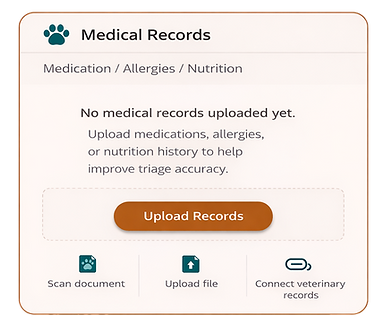
The guided assessment flow structures symptoms input into clinically relevant signals that inform the triage engine.

Pet Profile Context
Medical Records input
Symptom Assessment Entry
Adaptive Symptom Triage
Clinical signals are extracted from structured symptom inputs to determine severity tier and recommended care pathway. The system begins with a structured pet profile, ensuring symptom analysis is evaluated against known medical history, breed, and baseline characteristics.


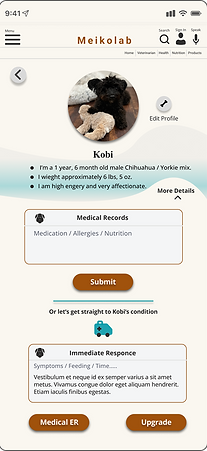
The symptom assessment experience is designed to progressively gather critical information while minimizing user friction. By grounding triage in the pet's profile and medical records, the system evaluates symptoms within real medical context rather than isolated inputs. This approach improves triage accuracy while maintaining a calm, guided interface for users during moments of uncertainty.
Once baseline information is confirmed, the interface routes users into structured symptom assessment or direct emergency escalation when needed.
Adaptive Symptom Interview
The system conducts an adaptive diagnostic interview, adjusting questions in real time to gather the most relevant clinical signals.

Symptom Identification
The triage system dynamically adapts its questions based on the user's initial symptom input, progressively refining the clinical context of the case. By combining structured inputs with intelligent follow-up prompts, the interface helps identify key risk signals while minimizing user effort. This adaptive interview model allows the system to quickly narrow potential conditions and determine the appropriate severity tier, enabling faster and more accurate escalation when veterinary attention may be required.


Symptons Identification
Adaptive Diagnostic Question
Context Expansion
Preliminary Risk Classification


These screens demonstrate how the triage experience transitions from onboarding into structured symptom discovery. By grounding the interaction in the pet's profile, health history, and contextual information, the system can ask progressively smarter diagnostic questions while minimizing user effort. Each step reduces ambiguity, guiding pet owners from initial concern toward a clear clinical pathway. The result is an interface that balances empathy, clarity, and medical rigor, transforming early symptom reporting into actionable veterinary insight.
Risk Classification Interface
Collected signals are evaluated through the triage model to determine severity tier and recommended response pathway.

From concern to care in four steps.
MeikoLab's triage system transforms uncertain symptom signals into structured medical guidance through contextual pet data, AI-driven classification, and access to veterinary expertise.


Recomendation Card
Human Vet Interface
User- reported symptoms are combined with the pet's profile data to evaluate risk and severity. The system then guides the owner toward the most appropriate care path, from monitoring to veterinary consultation or urgent care.

System Function:
-
The interface captures the first symptom signal and initiates the triage pathway.
-
User profile data helps the AI refine symptom interpretation.
-
AI triage determines urgency and surfaces professional care options.
-
Authentication and access control allow the system to initiate consultation or recommendations.


From Concern to Clarity
A guided experience that turns symptoms into insight, connecting pet owners to the right care at the right moment.
By combining symptom signals, pet profile context, and veterinary insight, the system transforms uncertainty into clear next steps, helping pet owners move confidently from concern to care.
Escalation Recommendation System
Collected signals are evaluated through the triage model to determine severity tier and recommended response pathway.
The Escalation Recommendation System translates symptom signals into clear care pathways. By combining adaptive triage logic, veterinary knowledge, and contextual pet data, the platform evaluates risk in real time and guides pet parents toward the most appropriate next step, from monitoring at home to veterinary or emergency care.


The escalation framework translates user-reported symptoms into structured clinical insight. By combining symptom input, adaptive AI triage, and risk classification, the system guides pet parents to clear, appropriate care pathways, ranging from at-home monitoring to veterinary or emergency care.

Adaptive triage flow translates symptom signals into risk classification and clear veterinary care recommendations.

An AI-guided triage flow that transforms user symptom signals into risk classification and clear, actionable veterinary care pathways.

A unified design token system ensures consistency across the triage experience, aligning color semantics, severity states, spacing, and typography into a scalable product foundation.
Component System & Interface Patterns
Design tokens establish the foundation, but components translate those foundations into real product interactions. The MeikoLab component system ensures that triage flows, symptom reporting, and care recommendations remain consistent, scalable, and easy to understand across the entire product experience.

Each component is designed to communicate medical context clearly, reduce cognitive load for pet parents, and support rapid decision-making during moments of uncertainty.


Product Vision
Designing an Intelligent Care Companion
MeikoLab's vision redefines how we care for our furry friends by leveraging advanced AI to provide personalized, proactive, and seamless pet health management. Our goal is to empower pet owners with timely insights and actionable steps to ensure the best possible care for their dogs and cats.

MeikoLab combines behavioral insights, veterinary knowledge, and AI-guided care into a single trusted companion for dog and cat health awareness.

From Search to Care: The MeikoLab User Journey

MeikoLab Product Experience in Motion
MeikoLab envisions a future where pet owners receive calm, reliable health guidance during moments of uncertainty.
By combining behavioral signals, AI analysis, and veterinary knowledge, the platform transforms scattered information into actionable care insights.
MeikoLab combines behavioral insights, veterinary knowledge, and AI-guided care into a single trusted companion for dog and cat health awareness.
Product Vision in Motion
This visual presents the MeikoLab mobile experience as a calm, intelligent companion for dog/pet owners navigating moments of uncertainty about their pet's health. The interface brings together symptom awareness, personalized pet profiles, veterinary guidance, and proactive care planning within a single, intuitive ecosystem. By combining accessible health knowledge with structured care tools, MeikoLab transforms scattered information into a true digital support system, helping owner move from concern to clarity with confidence.

MeikoLab Mobile Experience

Designing a calm, trustworthy digital experience that helps dog owners interpret early health signals and access reliable guidance when uncertainty arises.

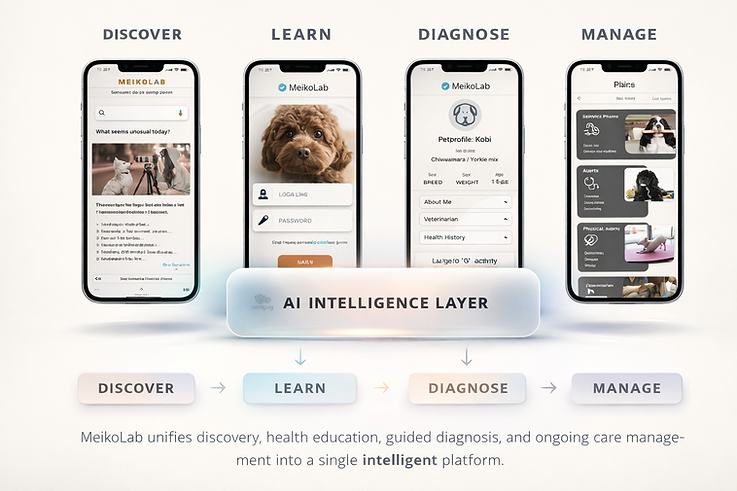
MeikoLab connects discovery, health education, guided diagnosis, and ongoing care management into a unified digital experience designed to support confident pet health decisions.